

How to learn faster comes down to changing how you study, not how long. Research favors testing yourself, spacing sessions over days, mixing problem types and explaining ideas in your own words. These methods feel harder than rereading, but they produce memory that lasts.
Below you get seven techniques, a table with concrete examples and a weekly plan you can copy.
Key takeaways
- Practice testing and spaced sessions have the strongest research support.
- Rereading and highlighting feel productive but rank low in reviews.
- Interleaving, elaboration, self-explanation and dual coding build understanding.
- A short weekly routine beats one long cramming night.
What does it mean to learn faster?
Learning faster does not mean absorbing a textbook in one evening. It means needing fewer hours to reach the same level of recall and understanding a month later. Speed is measured by what you can still use, not by pages covered.
The most useful single source here is a 2013 review by psychologist John Dunlosky and colleagues, published in Psychological Science in the Public Interest. They compared ten common study methods. Practice testing and distributed practice earned the highest utility ratings, while highlighting and rereading earned the lowest. You can read the full paper on the SAGE Journals site.
Tip: Judge a session by what you could write from memory afterward, not by how familiar the notes feel.
Which study techniques actually work?
Seven techniques show up again and again in learning research. Each one forces your brain to work a little harder during study, which is exactly why the memory sticks.
| Technique | What you do | Example |
|---|---|---|
| Spaced repetition | Review at growing gaps | Day 1, 3, 7, 14 |
| Retrieval practice | Recall without notes | Write what you remember |
| Interleaving | Mix problem types | Alternate algebra and geometry |
| Elaboration | Ask why it is true | Why does heat expand metal? |
| Self-explanation | Explain each step aloud | Narrate a worked proof |
| Dual coding | Pair words with visuals | Sketch a process diagram |
| Concrete examples | Attach a real case | Link inflation to grocery prices |
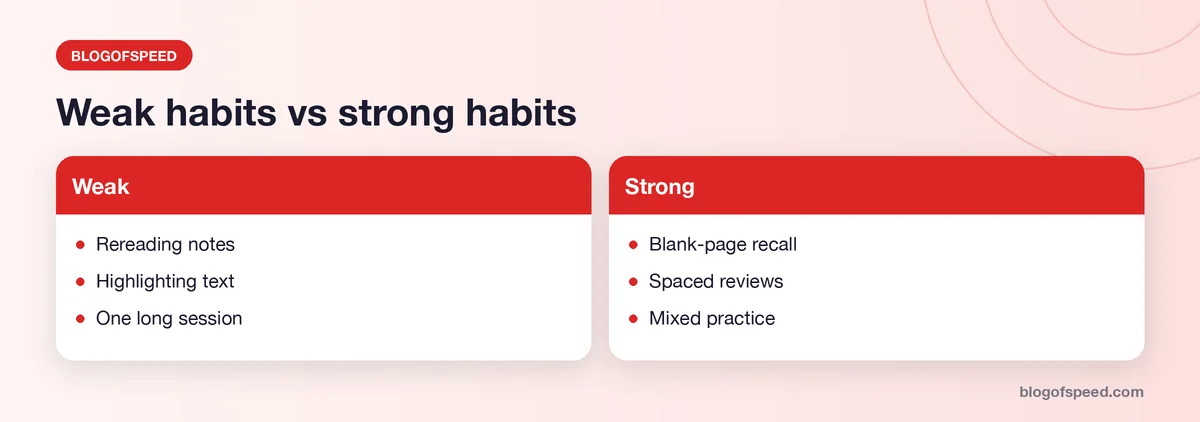
Note: Rereading and highlighting feel smooth because the material looks familiar. Familiarity is not recall, so do not count them as real study time.
How do spaced repetition and retrieval practice work?
These two techniques pair naturally, so treat them as one routine.
Why spacing beats cramming
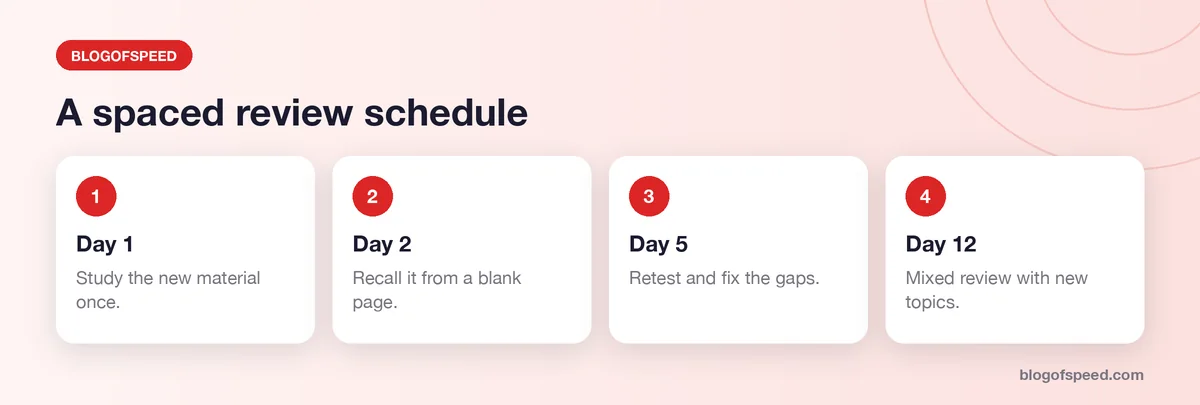
German psychologist Hermann Ebbinghaus described the forgetting curve in 1885: new memories fade quickly unless you revisit them. A large 2006 meta-analysis by Nicholas Cepeda and colleagues found that spreading study across days generally beats packing the same time into one block. Each return visit tells your brain the information matters.
How to test yourself without notes
In a well-known 2006 study, Henry Roediger and Jeffrey Karpicke had students read a passage, then either reread it or take a recall test. A week later, the tested group remembered more. Researchers call this the testing effect.
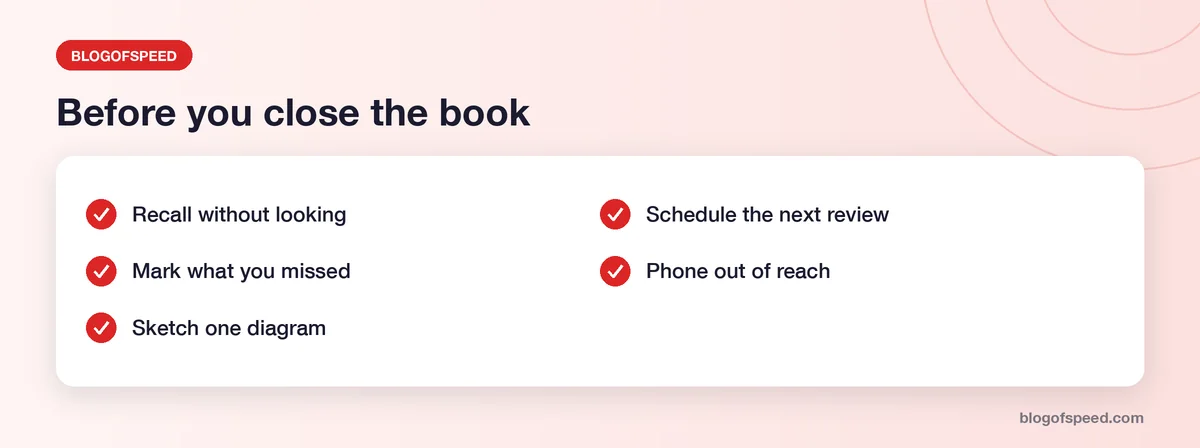
- Close the book after studying a section.
- Write everything you remember on blank paper for five minutes.
- Open the notes and mark what you missed.
- Put the missed items on your next review day.
Flashcard apps such as Anki (free, open-source flashcard software) automate the spacing, but a paper calendar works too. If you also read a lot, pair this routine with the methods in these speed reading techniques so you retain what you read quickly.
Why does interleaving feel harder but work better?
Interleaving means mixing different problem types in one session instead of finishing one type before starting the next. Blocked practice feels smooth because you repeat the same move. Interleaved practice forces you to first identify which method a problem needs, and that choice is the real skill on an exam.
Doug Rohrer and Kelli Taylor tested this in 2007 with math practice. Students who mixed problem types scored lower during practice but higher on a later test than students who practiced one type at a time.
A simple mixed practice session
- Studying for a driving theory test: mix road signs, right-of-way rules and speed limits in one set.
- Learning Spanish: alternate verb conjugation, vocabulary and listening in a single hour.
- Preparing for finance exams: shuffle bond pricing, ratios and time-value questions.
Tip: If a session feels slightly frustrating but you are still getting about two thirds right, the difficulty is probably in the useful zone.
How do elaboration, self-explanation and dual coding help you understand?
Recall methods fix facts in memory. These three methods help you connect facts so they make sense.
Ask why, then answer it
Elaborative interrogation means asking “why is this true?” and answering from what you already know. Reading that mitochondria produce energy is weak. Asking why muscle cells contain so many of them forces a link to energy demand.
Explain steps in your own words
Self-explanation means describing the reasoning behind each step of a worked example. The Feynman technique, named after physicist Richard Feynman, is a popular version: explain the idea as if teaching a beginner, and every place you stall marks a gap.
Combine words with pictures
Dual coding, a theory from psychologist Allan Paivio, says verbal and visual information are processed in separate channels, so pairing them gives you two routes to the memory. Sketch the water cycle with labels instead of copying a paragraph about it. Rough drawings are fine.
Example prompt for a study partner or an AI tutor: Ask me five questions about the French Revolution, one at a time. Wait for my answer, tell me what I missed, then ask a follow-up that starts with why.
What does a weekly study plan look like?
A plan removes the daily decision about what to do. This one assumes about four hours of study a week for a single subject, and you can scale it up or down.
| Day | Time | Focus |
|---|---|---|
| Monday | 45 min | Learn new material, sketch a diagram |
| Tuesday | 30 min | Blank-page recall of Monday |
| Thursday | 45 min | Mixed practice problems |
| Saturday | 60 min | Explain topics aloud, fix gaps |
| Sunday | 20 min | Plan next week’s review list |
Protect the sessions that matter by placing them on your calendar as fixed blocks. The approach in this guide to batching and time blocking works well for study as much as for work.
Sleep matters too. Memories consolidate overnight, so cutting sleep to study more usually backfires. For ideas on resting well between hard sessions, see this recovery optimization guide.
What mistakes slow your learning down?
Most slow learners are not lazy. They pick comfortable methods that give a false sense of progress.
- Passive review: rereading notes three times instead of testing yourself once.
- Marathon sessions: a six-hour block on one day instead of six short ones.
- Skipping feedback: practicing without checking answers, so errors get rehearsed.
- Studying with distractions: a phone beside you splits attention and weakens encoding.
Small, repeatable routines tend to beat heroic efforts. The argument in this piece on keystone habits applies directly: one dependable daily study habit is worth more than a clever hack.
Frequently Asked Questions
What is the fastest way to learn something new?
Start with a short first pass to get the outline, then switch quickly to recalling it from memory. Test yourself the next day, then again after several days. Active recall and spacing produce more durable memory per hour than rereading or highlighting.
How long should I study before taking a break?
Many learners do well with focused blocks of 25 to 50 minutes followed by a five to ten minute break. The exact length matters less than full attention during the block. Stand up, move and avoid your phone so the break actually rests your mind.
Does spaced repetition work for every subject?
It works best for material you must remember, such as vocabulary, definitions, formulas and historical facts. For skills like writing or coding, pair it with deliberate practice. Review key concepts on a schedule while you spend most of your time building things.
Can I learn faster by studying at night?
Timing matters less than sleep. Studying before bed can help because sleep supports memory consolidation, but only if you still get a full night. A late session that cuts your sleep short will cost you more than it gains.
Where should you start to learn faster?
Pick one subject and one technique this week. Start with a five-minute blank-page recall after each session, because it costs almost nothing and gives immediate feedback. Add spacing next, then interleaving. In a month you will have a routine that works.