
How to be more productive comes down to four areas: planning your day before it starts, protecting focus, using a few good tools, and managing your energy. Fast workers do not rush. They remove friction. Here are 12 habits, each with an example you can copy today.
Start with two or three habits, not all twelve. Small changes you repeat beat big overhauls you abandon.
Key takeaways
- Plan the day the evening before and pick one must-win task.
- Work in focused blocks and keep your phone out of reach.
- Use one task list, one calendar and a few automations.
- Protect sleep, movement and breaks, because energy sets your speed.
How can you be more productive by planning your day?
Fast workers spend five minutes deciding what matters so they do not spend an hour deciding while working. Planning habits cost little and pay back all day.
Habit 1: Write tomorrow’s plan tonight
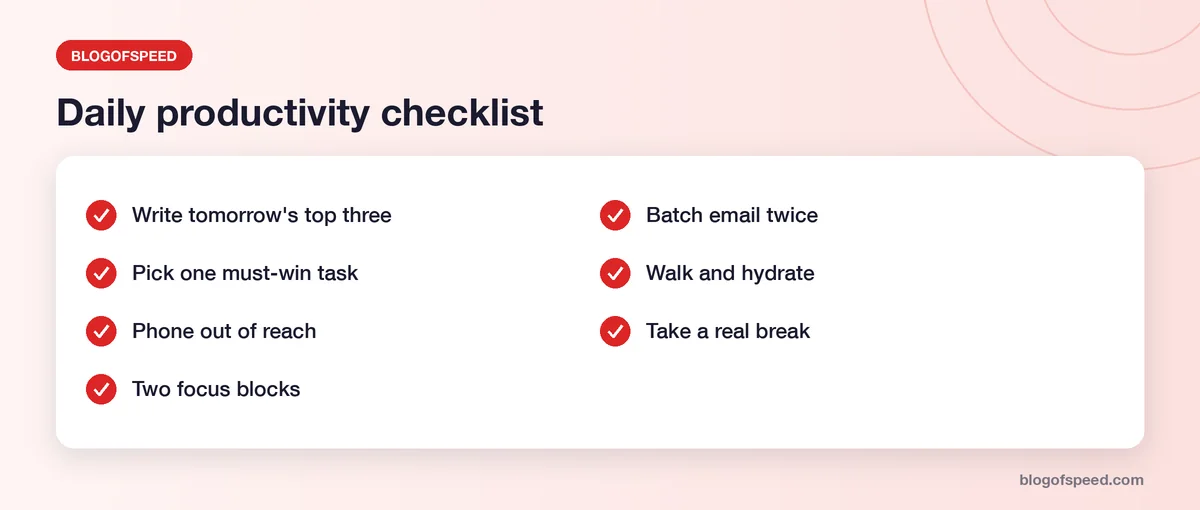
Before you close your laptop, list the three tasks for tomorrow. Example: “Send the Q3 budget draft, review two pull requests, book the dentist.” You wake up with a decision already made, which removes the slow start many people have at 9 a.m.
Habit 2: Pick one must-win task
Circle the single task that would make the day a success even if everything else slipped. Do it first, before email. A designer might choose “finish the landing page hero section” and leave the rest for the afternoon.
Habit 3: Sort tasks by urgency and importance
The Eisenhower matrix splits tasks into four boxes: do now, schedule, delegate, drop. Anything urgent but unimportant, such as most meeting invites, is a candidate to delegate or decline. The idea is part of classic time management theory.
Tip: If a task takes under two minutes, do it immediately. If it takes longer, give it a calendar slot instead of leaving it on a list.
How do you stay focused for hours at a time?
Focus is the habit group with the biggest payoff, because switching between tasks costs time every time you do it. These three habits protect your attention.
Habit 4: Work in timed focus blocks
The Pomodoro Technique uses 25 minutes of work followed by a 5 minute break. Many people prefer 50 minutes on and 10 off for deeper tasks like writing or coding. Pick one rhythm and stay with it for a week before judging it.
Habit 5: Put your phone out of reach
A phone face down on the desk still pulls at you. Put it in a drawer or another room during each block. If you need it for calls, turn on Do Not Disturb and allow only two or three favorite contacts.
Habit 6: Batch shallow work
Group email, chat replies and admin into two fixed windows, for example 11:30 and 4:00. Our guide on fast email management workflows shows how to clear an inbox in a single pass. For the mindset behind this, read why focus beats hustle.
Note: Multitasking feels efficient but usually produces slower work and more mistakes. Finish one task before you open the next.
Which tools help you work faster without adding clutter?
Tools should remove steps, not add them. Fast workers keep their setup small and review it every few months.
Habit 7: Keep one task list
Tasks scattered across sticky notes, email flags and three apps get lost. Choose a single list, such as a notes app or a simple to-do manager, and capture everything there.
Habit 8: Automate repeated steps
If you do something more than three times a week, look for a shortcut. Examples include text expanders for common replies, email filters that label newsletters, and calendar booking links that end the “what time works?” back and forth.
Habit 9: Learn your top ten shortcuts
Keyboard shortcuts for copy, paste, switch window, search and screenshot save a few seconds each time. Across hundreds of repetitions a week, that adds up to real time. Write the ten you want on a sticky note and use them until they are automatic.
Tip: Audit your tools once a quarter. If you did not open an app in the last month, remove it.
Does energy matter more than time for productivity?
Time is fixed at 24 hours, but the quality of those hours is not. Tired people work slowly and make more errors, so energy habits are productivity habits.
Habit 10: Protect your sleep schedule
Go to bed and wake up at roughly the same time every day, including weekends. A consistent rhythm makes mornings sharper than adding one extra hour on a random night. For a deeper look, see our piece on energy optimization.
Habit 11: Move and hydrate during the day
Stand up every hour, walk for five minutes, and keep a water bottle on the desk. A short walk after lunch also helps you avoid the mid-afternoon slump. Mild dehydration can make concentration harder, which is covered in how hydration boosts brain speed and focus.
Habit 12: Schedule real breaks
A break means leaving the screen, not switching to social media. Look out a window, stretch or make tea. If you plan hard tasks for your natural peak hours, usually mid-morning for many people, you can leave easy tasks for the dip after lunch.
Which habits are quick wins and which take time?
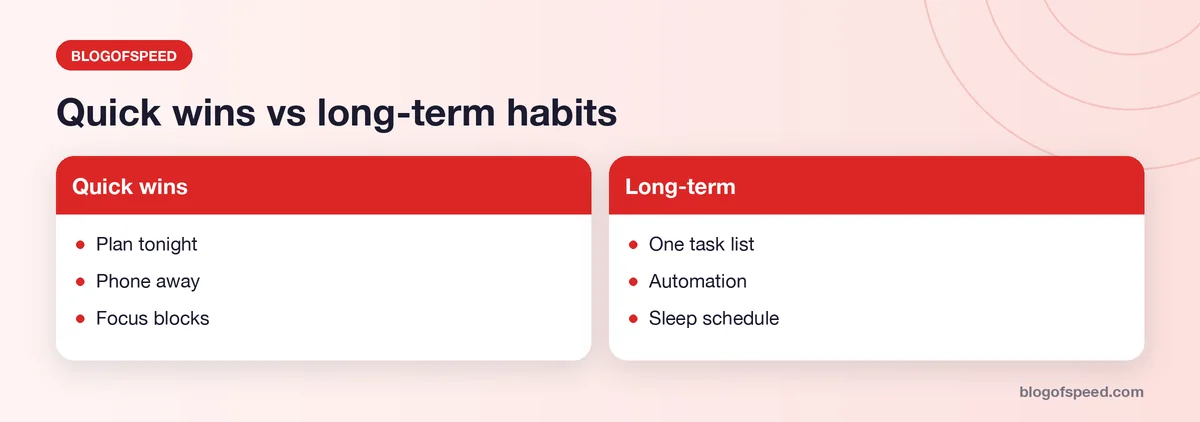
Some habits help the same day, while others need weeks to feel natural. Use this table to choose where to begin.
| Habit | Type | Time to feel it | Effort |
|---|---|---|---|
| Tomorrow’s plan tonight | Quick win | 1 day | Low |
| Phone out of reach | Quick win | 1 day | Low |
| Timed focus blocks | Quick win | 1 week | Medium |
| Single task list | Long-term | 2 to 3 weeks | Medium |
| Automating repeat tasks | Long-term | A few weeks | Medium |
| Consistent sleep schedule | Long-term | Several weeks | High |
New habits stick when they are tied to something you already do. Say it as a rule: “After I pour my coffee, I write my three tasks.” The science and routines behind this are covered in our article on habit formation.
How should you build a productive week from these habits?
Do not start all twelve at once. Choose one habit from each group over a month and track whether it worked.
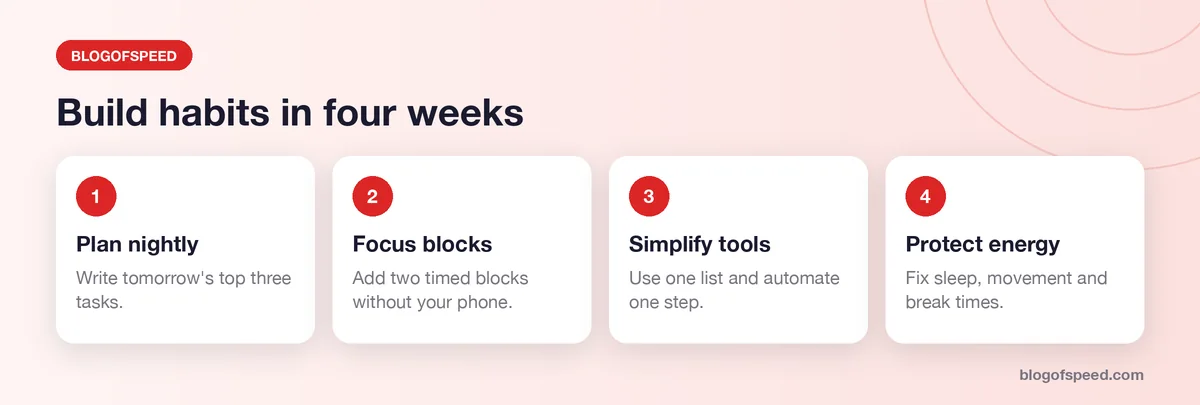
- Week 1: write tomorrow’s plan each evening and pick one must-win task.
- Week 2: add two timed focus blocks per day with your phone out of reach.
- Week 3: move all tasks into one list and automate one repeated step.
- Week 4: fix your sleep and break schedule, then review what stuck.
Weekly review, Friday 4:30 p.m.: What did I finish? What took longer than expected? Which one habit helped most? Which one habit do I drop or change next week?
A short weekly review turns guessing into learning. Keep the habits that moved your output and drop the rest without guilt.
Frequently Asked Questions
What is the fastest way to be more productive today?
Pick the single task that matters most, silence your phone, and work on it for 25 to 50 minutes before opening email. That one change removes most of the distraction that eats the morning. Repeat it after lunch and your day will already look different.
How long does it take to build a productivity habit?
It varies by person and habit. Simple actions, like writing a plan at night, can feel normal within a couple of weeks, while bigger changes like sleep routines take longer. Focus on consistency and attach each habit to an existing routine so it needs less willpower.
Do productivity apps really make you faster?
They help only when they remove steps you repeat often, such as sorting email or scheduling meetings. Too many apps create new overhead. Start with one task list and one calendar, then add automation only for tasks that annoy you every week.
How can I stay productive when I feel tired?
Switch to low-demand tasks like filing, replying to messages or planning, and save deep work for when you are alert. Take a short walk, drink water, and consider a brief nap. Then fix the cause by improving your sleep schedule.
Should I work longer hours to get more done?
Usually not. Long hours often lower the quality of work and leave less energy for the next day. Shorter, well-protected focus blocks with real breaks tend to produce more finished work than long days spent half-distracted.
Where should you start with these habits?
Pick one habit from planning and one from focus, and run them for seven days. Write down what changed, then add a tool or energy habit.